


Sharing the square
‘Sharing the Square’ was a community engagement programme to inform the regeneration of Castle Square and surrounds/linkages.
spacetocreate in association with Ruth Essex, Heidi Baker and Janetka Platun were commissioned by Pembrokeshire County Council (PCC) to creatively explore and develop a better understanding of the lived experience of users of the square during March- June 2024. The community engagement contract built on historic engagement programmes in Haverfordwest such as Confluence 2014-2017 to gain a deeper and more specific understanding of the square’s historical importance and significance to the community as well as its user profile.
This work forms part of a wider town centre regeneration project of Pembrokeshire’s town centres being adopted by Pembrokeshire County Council which will feed into design team work and future projects in the town.
Like many towns across the UK, Pembrokeshire’s town centres need to adapt to remain vibrant. COVID has further contributed to changing the demands on our towns and work is required to adapt our historic town centres to modern retail and social engagement requirements.
The wider regeneration of Castle Square and relevant links is funded through UK Shared Prosperity Fund, Levelling Up Fund and Transforming Towns Fund.



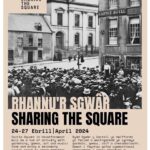
Sharing the Square was a creative community engagement process which took place during March-June 2024 to involve a wide demographic of users of Castle Square and Haverfordwest town centre in sharing memories and hopes for how the square and it’s links could be improved. The engagement methodology included a mixture of online and in person meetings and information sharing, targeted and public events, collaboration with local initiatives and a four-day residency with a programme of events and activities in Castle Square.
The team employed a tactical urban prototyping process using simple and relatively cheap action focused activities to catalyse positive attitude and conversations around memories, connections (Castle Link, bus and train stations), new ideas and change. Over 950 people engaged with the process, feedback was logged through interviews, conversations, feedback forms (online and paper), comments on blackboards, creative artwork and observational analysis and public feedback and reactions to interventions.


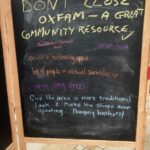
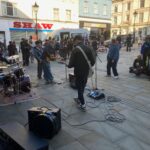
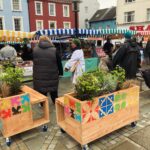

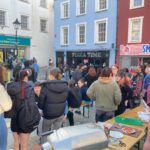
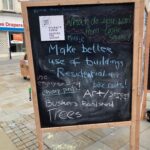
It was clear that people wanted an active, sociable and greener space which could act as the town’s gathering place. Most mentioned were a need for trees, greenery, nature; events, art, music, busking, markets, pop ups; café culture, sitting, socialising. Other key themes coming out were cleaner environment, visual improvements, lighting, shopfronts, signage; more for young people, families and children; reduce dominance of car; improved accessibility and a clear pleasant link to the castle.
Key recommendations of this research were:
People and programming is key- Design is not enough. Collaborative Programming would kick start a more active space building from the grassroots bringing the square back into life and changing the dynamics.
Encourage conviviality- Incentivising usage and and sending out proactive, can-do messaging to the public. Encouraging local businesses and stalls to put out chairs, tables, planters etc’
Better more inclusive design- Design needs to support an active programmable social space which feels owned by the people. There is a desire and need for more greenery, trees, seating, better frontages, a space that looks and feels special and cared for.
Need to reduce impact of traffic- Integrating the highway into design plans and considering shared space design approach. Restricting the volume and type of traffic opens up possibilities for improved environmental quality and greater flexibility in how the square could function and develop.